Rich and luscious, homemade ricotta is easy and amazing!

Let’s cut right to the chase: this is one of the easiest DIY food projects you’ll ever do, and the effort-to-reward ratio is super high. I just wanted to get that out there, in case the word “homemade” made you want to run screaming for the Back button.
I don’t know what it is about dairy, but it’s been a sort of hobby of mine to try DIYing the homemade goodies that can come from a simple glass of milk. Butter [2], compound butter [3], buttermilk [4], ice cream [5].
The homemade butter — my first attempt, years and years ago, was amazing. So fresh and sweet, it reeled me in. Homemade ice cream — swoon.
But I think homemade ricotta tops them all. I didn’t particularly care for ricotta — buried in lasagne, okay; spread on a cracker, no. freakin’. way — until I first tried someone else’s homemade ricotta. It was a revelation — there’s just no comparison. It’s almost two different foods altogether, store-bought vs. homemade.
And, like I said first thing: it’s so easy.
Here are the steps:
Pour.
Heat.
Squeeze.
Stir.
Drain.
Wait.
Gottit? Good. 🙂
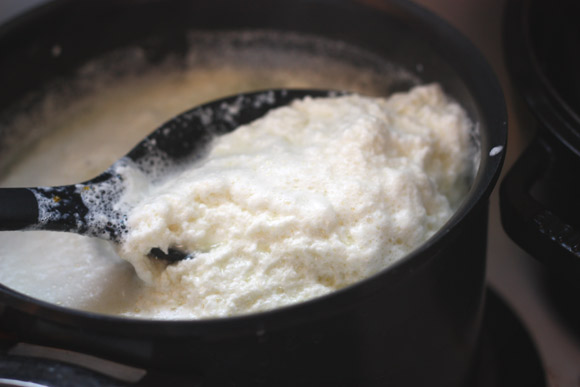
(In the photo above, the creamy ricotta curds form after adding acid — in this case, lemon juice — to the hot milks.)

Ricotta sitting in the drainer for a leisurely drip. All told, the ricotta took about 15 minutes behind the stove, followed by a one-hour rest in the sieve. While it drained, I ran to the grocery store to buy the ingredients for the evening’s dinner (the pizza rustica [6] from yesterday’s post). By the time I returned, lusciousness had formed.
Control the texture by altering the drain time. For a smooth, super-creamy, spreadable ricotta, stop short of an hour, about 45 minutes. For use in recipes, such as lasagna or pizza rustica, let drain for an hour and a half (or even overnight). You’ll want a drier curd in those recipes, one that doesn’t exude water during baking.
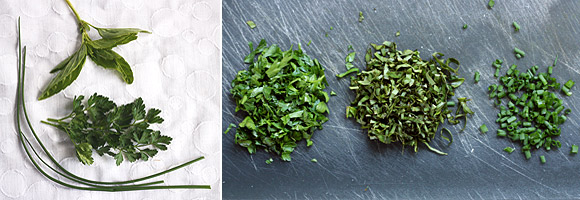
The ricotta is absolutely delicious on its own, but fresh herbs add a nice twist. Parsley and chives overwintered in my garden, so they were natural choice for me. I purchased basil — my seedlings are still too small to pluck — to go with the Italian pizza rustica.

I’ve tried numerous variations of the recipe for homemade ricotta, but this one is my favorite: the secret is the buttermilk.
It’s amazing that something so disgusting to drink can make everything — from bread to cake to salad dressings — taste somehow fresher, lighter and richer, all at the same time.
Karen xo
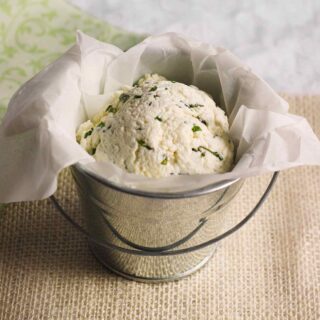
Homemade Herb Ricotta

Ingredients
- 8 cups whole milk 2 quarts or 1/2 gallon US
- 1 cup heavy cream
- 1/2 cup cultured buttermilk
- 3 tablespoons freshly squeezed lemon juice
- 1/2 teaspoon salt
- 2 tablespoons total of your favorites herbs minced (I used flat leaf parsley, basil and chives)
Special Equipment:
- cheesecloth
- thermometer instant read is handiest
Instructions
- Line a large sieve or colander with a double layer of fine-mesh cheesecloth and place it over a large bowl.
- Slowly bring the milks, cream and salt to a low boil in a large (4 qt or more) heavy pot over medium heat, stirring occasionally but shallowly, to prevent scorching (try not to scrape the bottom of the pot while stirring once the heat gets going. Scorching happens, and you don't want brown bits floating around in your ricotta). When the mixture reaches 190°F, remove from the heat and add the lemon juice. Stir gently until the mixture curdles (i.e., when the curds separate from the liquids in big, floating icebergs), about 2 minutes.
- Spoon the solid curds into the lined sieve and let drain for an hour (or an hour and a half for a drier curd). Move the ricotta to a bowl and give it a good stir. If the curds are too crumbly (i.e., too dry), add a bit of the drained liquid, stirring well to incorporate until you reach the desired consistency. Add the herbs and work them in with a spoon to combine. Cover and chill in the fridge. Discard the liquids or use for another purpose, such as bread-making (the liquid by-product of this process is whey, and whey is a wonderful substitute for the liquids in a yeast bread recipe). The ricotta will keep in the refrigerator for 2 to 3 days.